
The Employer Coordinated PortfolioTM is a strategy that ComposedPro offers when its clients have accounts both INSIDE their employer (401k, 403b) as well as OUTSIDE their employer (IRAs, brokerage accounts).
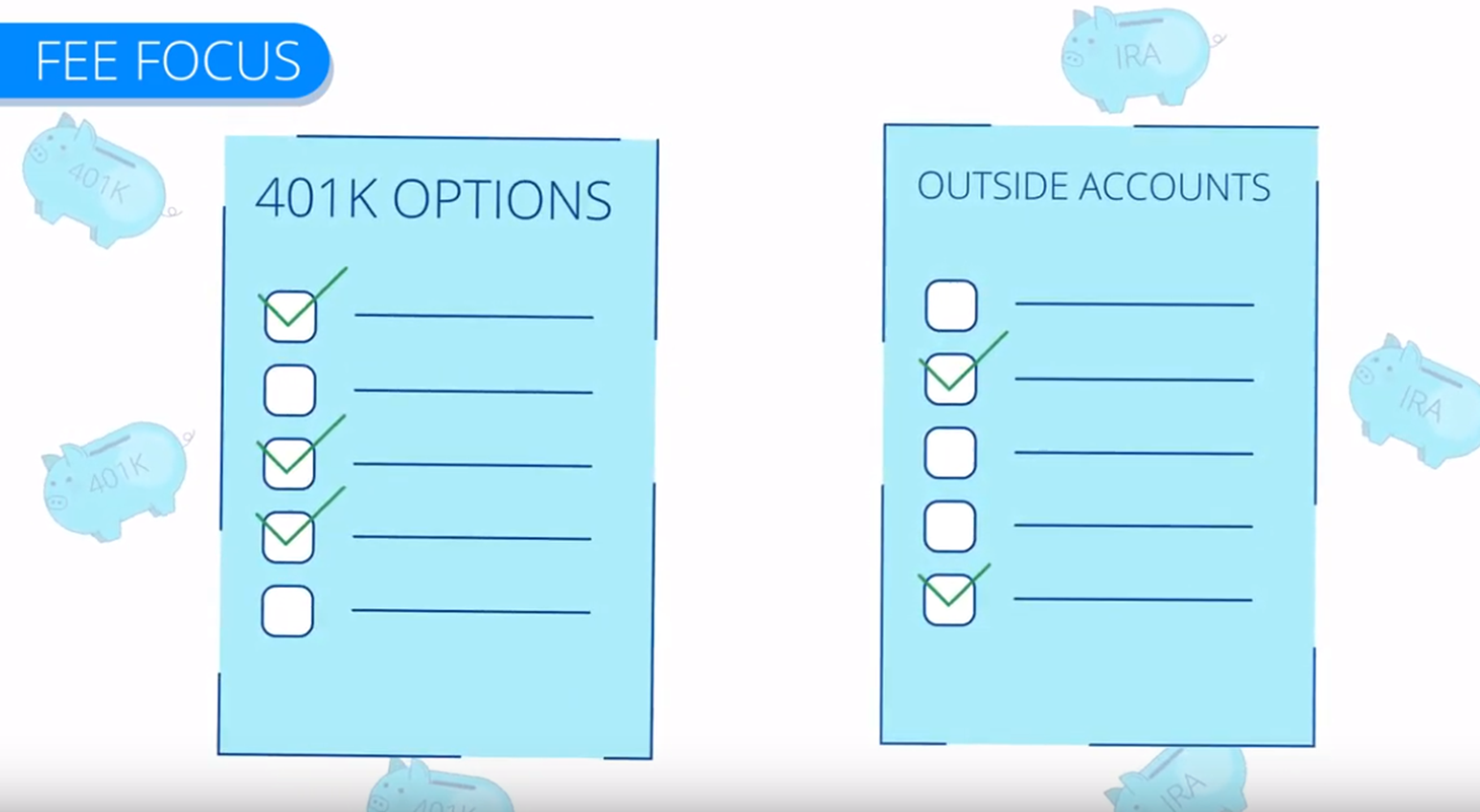
It performs two very important tasks in order to lower FEES and TAXES dragging down your portfolio.
FEES
The Employer Coordinated PortfolioTM first looks at the accounts INSIDE your employer where your investment options may be limited and chooses GOOD investment options for you. GOOD investment options are those that have low fees and perform as expected. Read more about ComposedPro's Investment Methodology.
Your 401k or 403b employer account may not have enough GOOD investment options, and that is where your OUTSIDE accounts come into play. Your IRA and brokerage accounts have nearly unlimited options, and we use these accounts to invest where your employer accounts may be lacking.
This method allows us to most times reduce the fee impact on your overall portfolio.
TAXES
Because the Employer Coordinated PortfolioTM contains with multiple accounts, it can smartly place investments into the accounts where they belong that save you in taxes. If you invest in bad Target-Date Funds, you may be losing on taxes because Target-Date Funds throw all types of investments into ONE account. For example, if you invest in a Target-Date Fund in your 401(k), the underlying investments U.S stocks may be poorly placed in the 401(k). The U.S stocks placed in the 401(k) - a tax-deferred account - would eventually be subject to ordinary income tax rates when you make a withdrawal from the 401(k). If they were instead placed in a taxable account, they may be eligible to be taxed at lower capital gains tax rates. We provide an easy to understand Smart Location ScoreTM that quickly shows you how well your investments are placed.
For a quick summary of the Employer Coordinated PortfolioTM, please watch this short video below:
Disclosures:
Please note that higher tax-deferred balances could result in higher required minimum distributions (RMDs) in retirement. This should be considered when implementing any contribution recommendations or other such strategies that seek to optimize across tax-exempt, tax-deferred, or taxable accounts. If you are seeking to minimize RMDs, a contribution strategy that recommends a higher tax-deferred balance in your portfolio may not be appropriate. Please consult your tax advisor when implementing any strategy that attempts to lower income taxes.
Clients may not realize the benefits of asset location discussed herein. Factors that affect an asset location strategy include, but are not limited to, market performance, the relative size of each account included in financial plan, the equity exposure of the portfolio, the frequency and size of deposits into the various accounts, the tax rates applicable to the investor in a given tax year and in future years, and the time elapsed before liquidation of any of the accounts becomes necessary.
Nothing herein should be interpreted as tax advice. ComposedPro does not represent in any manner that the tax consequences described herein will be obtained or result in any particular tax consequence. Please consult your personal tax advisor as to whether ComposedPro's asset location strategy is a suitable strategy for you, given your particular circumstances. The tax consequences of asset location are complex and uncertain. You and your tax advisor are responsible for how transactions conducted in your account are reported to the IRS on your personal tax return. ComposedPro assumes no responsibility for the tax consequences to any client of any transaction.
Clients may not realize the full benefit of the fee reduction discussed herein. Factors that could limit ComposedPro's ability to lower the average expense ratio for a client's portfolio include, but are not limited to, the options available within an employer account, investments the client marks as 'Do Not Sell', or other constraints contained within the client's portfolio.
Comments
0 comments
Article is closed for comments.